Ghorepani Rhododendron Trekking
Latest Essential Updates
- New Road Access (2026): Jeep roads now reach closer to Ulleri and Hile, making some sections dusty. The Stone Staircase route is better for a natural trekking experience.
- Mandatory Guide Policy: All foreign trekkers must join a licensed guide in the Annapurna region. Solo trekking without a guide is not allowed.
- Digital Permit System (E-TIMS): TIMS cards are now fully digital. You must register through a trekking agency before starting the trek.
- Permit Costs: ACAP permit costs 3,000 NPR for foreigners. Getting it on the trail costs double, so apply in Kathmandu or Pokhara.
- Trail Condition: The trail is well-marked and easy for beginners. New 2026 improvements include better signs and waste points along the route.
Trip at a Glance
-

Country: Nepal
-

Trip grade: Moderate
-

Destination: Annapurna
-

Activities: Trekking
-

Accommodation: Lodge/Hotels
-

Meals: Full-board on trek
-
.png)
Transportation: Private vehicle/Plane
-

Maximum altitude: Poon Hill (3210m)
-
Trip Start / End: Kathmandu - Kathmandu
-
.png)
Best Season: March, April & early May
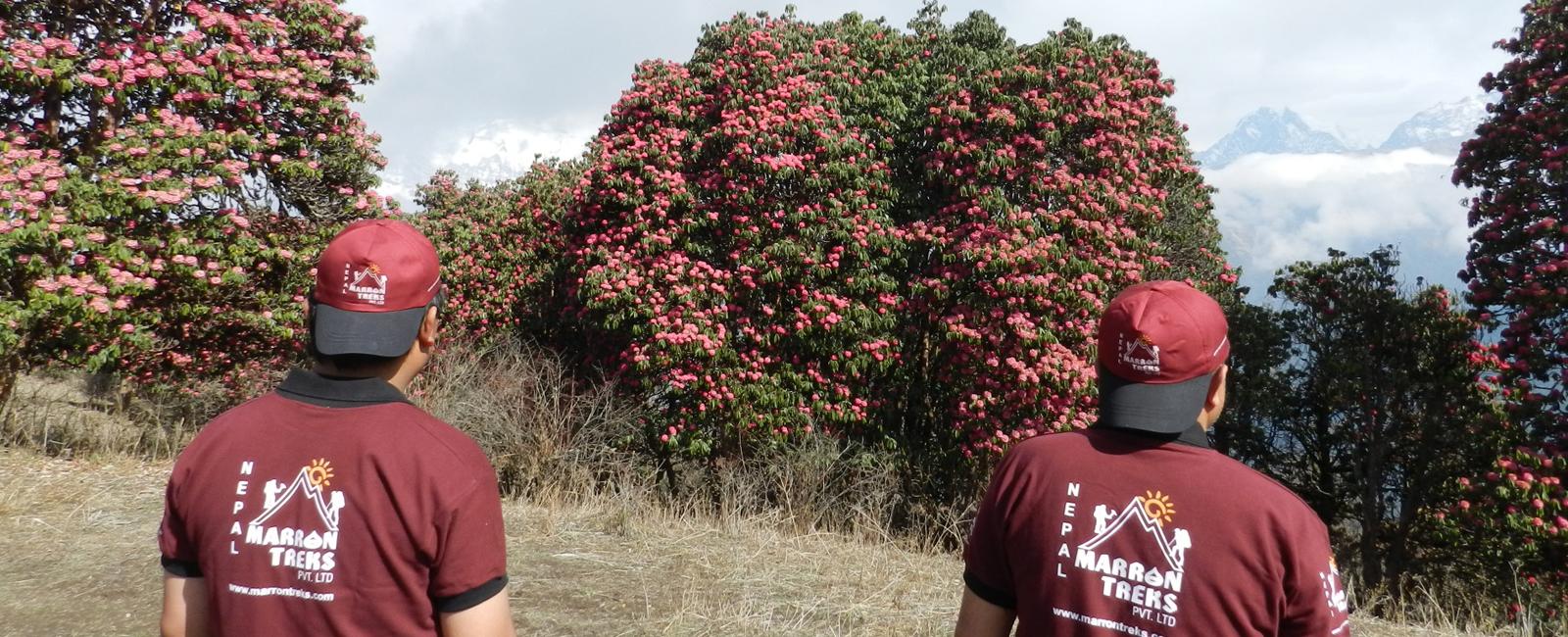
Ghorepani Rhododendron Trekking is one of Nepal’s most popular short treks, celebrated for its spectacular rhododendron forests, especially during spring when the hills are covered in vibrant blooms. The journey includes an early morning hike to Poon Hill (3,210 m), offering breathtaking sunrise views over the Annapurna and Dhaulagiri ranges.
With well-maintained trails, comfortable lodges, and stunning mountain scenery, this trek is ideal for travelers seeking a moderate, rewarding Himalayan experience in a short timeframe.
Ghorepani Rhododendron Trekking Highlights:
- Hike along one of Nepal's most popular short treks through beautiful rhododendron forest
- Poon Hill Sunrise Hike (3,210m) to witness the Annapurna and Dhaulagiri mountain ranges
- Scenic Himalayan trail passing through traditional Gurung and Magar communities like Ghorepani, Ghandruk, and Tadapani.
- Discover rich local culture and way of life in the mountains
- Walk through stunning terraced fields, waterfalls, and lush forests
Itinerary
This 7-day Ghorepani Rhododendron Trek itinerary takes you from Kathmandu through Pokhara, Ulleri, Ghorepani, Poon Hill, Tadapani, and Ghandruk with beautiful mountain views and rhododendron forests. It is a short and easy Himalayan adventure in Nepal, perfect for beginners who want stunning sunrise views and cultural village experiences.
Upon your arrival at the Tribhuwan International Airport in Kathmandu, you will be received by a representative from Marron Treks and then transferred to your designated hotel.
In the morning, take a short flight to Pokhara (25 min) and then drive to Ulleri along winding roads through lush woods, little towns, and lovely terraced fields. Get to Ulleri, a small traditional village with amazing views of the Annapurna range, Annapurna South, and Machapuchare (Fishtail).
Today you will enter the heart of the "Rhododendron Zone." The trail passes through ancient oak and dense rhododendron forests that will be in full bloom. The trail is a gentle but steady climb. As you approach Ghorepani, the peaks of Annapurna South and Hiunchuli begin to peer through the floral canopy.
To observe the sunrise from Poon Hill, one of the most popular viewpoints in the Annapurna Region, you should get up early in the morning. From Poon Hill, you'll observe the Annapurna Range, Dhaulagiri, Machapuchare (Fishtail), and other nearby peaks from all sides. The sunrise from here is amazing, with the mountains glowing in gold. Then hike back down to Ghorepani. After breakfast, trek toward Tadapani. This section offers perhaps one of the best rhododendron viewing in Nepal, with massive blooming rhododendron trees.
Today, we'll largely be walking downhill through gorgeous rhododendron trees and towns to Ghandruk. Get to Ghandruk, a picturesque Gurung village with traditional stone buildings and amazing views of Annapurna South and Machapuchare. Then take the beautiful mountain roads along the Seti River to get to Pokhara.
Take a quick, beautiful 25-minute flight back to Kathmandu. When you get to Kathmandu, you'll be taken to your hotel, where you may relax and refresh after your trip. In the evening is farwell dinner with cultural show.
A representative from Marron Treks will escort you to the airport for your final departure. Have a safe flight back home and we look forward to being your adventure companion in Nepal again.
What is included?
- Airport pick-up and drop services.
- Hotel accommodations in Kathmandu & Pokhara with breakfast on Twin Share Basis.
- Kathmandu/Pokhara/Kathmandu by a flight with guide.
- All trekking accommodations with Breakfast/Lunch/Dinner at local lodges.
- Drive to/from trek-start-point & trek-end-point by private vehicle.
- A comprehensive medical kit (will be carried by the trekking guide)
- Experienced Government licensed Trek Guide & Porter (1 porter for two people) including their food, accommodation, salary & insurance.
- Permits for Annapurna Conservation Area and TIMS (Trekkers' Information Management System)
- Farewell dinner with Nepalese cultural program.
- All government and local taxes.
What is not included?
- International airfare.
- Nepal entry visa fee – Visa can be obtained upon your arrival at the Tribhuvan International Airport in Kathmandu. (USD30 for 15 days)
- Lunch & dinner in Kathmandu or Pokhara.
- Personal travel insurance.
- Emergency rescue evacuation (to be covered by the client's travel insurance).
- Other expenses of personal nature (phone calls, laundry, battery recharge, extra porters, bottle or boiled water, hot shower etc.)
- Personal trekking equipment.
- Bar bills, alcoholic drinks & beverages.
- Tips or gratuities.
FAQ's
What is the Ghorepani Rhododendron Trek?
Known for the vivid rhododendron forests, the Ghorepani Rhododendron trek is a short, moderate trek in Nepal. For breathtaking sunrise views of the Annapurna and Dhaulagiri ranges, the trek includes an early morning hike to Poon Hill (3210 m).
What is the location of the trek?
The trek passes through places like Ulleri, Ghorepani, Tadapani, and Ghandruk in Nepal’s Annapurna region.
What is the highest altitude?
Poon Hill, at 3210 meters, is the highest altitude.
Can I get altitude sickness?
The risk of altitude sickness is moderate. Marron Treks prepares you with proper acclimatization, an experienced guide, and encourages slow ascent
Which season is best for this trek?
Spring (March, April, early May) is the best season for this trek. In this season, rhododendron forests are in full bloom. Additionally, autumn offers fresh mountain views and beautiful skies.
What is the temperature during the Ghorepani Rhododendron Trek?
The Ghorepani Rhododendron Trek typically experiences daily temperatures between 10°C and 20°C in the spring, but the nighttime temperatures at higher locations, such as Ghorepani, can drop between 0°C and 5°C.
What is the duration of the trek?
The trek takes about 7 days, including arrival, trekking, sightseeing, and final departure.
What permits are required for this trek?
TIMS (Trekkers’ Information Management System) and the Annapurna Conservation Area Permit(ACAP) are the required permits. Marron Trek will arrange the required permits.
Is this trek suitable for beginners?
With reasonable daily walking distances and well-maintained paths, this hike is indeed suitable for beginners.
Are there any age restrictions for the Ghorepani Rhododendron Trek?
There are no official age restrictions for the Ghorepani Rhododendron trek. Anyone with good health and physical fitness can participate in this trek.
Do Marron Treks provide a porter and guide for the Ghorepani Rhododendron Trek?
Yes, Marron Treks will provide a professional guide and a porter (1 porter for two people) for the Ghorepani Rhododendron Trek.
What accommodations will be provided during the Ghorepani Rhododendron Trek?
You will stay at cozy hotels in Kathmandu and Pokhara, whereas during the trek, local teahouses with basic twin rooms, which are simple yet comfortable, will be provided.
What are the foods that I will get during the Ghorepani Rhododendron Trek?
During the Ghorepani Rhododendron Trek, you will get breakfast, lunch, and dinner in teahouses. There will be dal bhat, noodles, soups, vegetables, toasts, tea, coffee, etc., with limited western options. The foods will be full of energy, which will keep you energetic. You can also bring snacks from your own home country according to your taste and preferences.
Can I get access to electricity, Wi Fi, and hot showers?
You can get these, but the teahouses might charge you extra. Marron Treks recommends you bring a power bank and extra batteries for your cameras for your ease.
Will there be ATM service during the trek?
During the trek, ATMs are not available anywhere, so we recommend that you to carry enough Nepalese Rupees before starting the trek.
Is travel insurance required for the Ghorepani Rhododendron Trek?
For the Ghorepani Rhododendron Trek, Marron Trek strongly advises getting travel insurance that should cover trekking activities, medical care, and emergency evacuation if necessary, even though it’s a moderate trek.
What are the essential items that I must pack for the trek?
Comfortable trekking shoes, warm layered clothes, a rain jacket, trekking pants, shirts, gloves, sunglasses, sunscreen, lip balm, personal hygiene products, basic medications, prescribed medications, a power bank, and extra batteries are the essential items that are necessary for the trek, which will guarantee your comfort and safety.
Am I allowed to pick the Rhododendron flowers on this trek?
No, it is strictly prohibited to pick the rhododendron flowers as they are preserved in the Conservation Area. However, you can enjoy the blooming flowers and photograph them.
Is the Ghorepani Rhododendron Trek difficult as compared to the Tinjure Danda Rhododendron Trek?
Yes, as compared to the Tinjure Danda Rhododendron Trek, this trek is longer and moderately difficult.
How challenging is the Ghorepani Rhododendron Trek compared to the Langtang Valley Rhododentron Trek?
The Ghorepani Rhododendron trek is less challenging than the Langtang Valley Rhododendron Trek.
Why should I choose Marron Treks for the Ghorepani Rhododendron Trek?
Marron Treks provides guides with professional knowledge and experience. We prioritize your safety and ensure your comfort. Personalized service is also available. Choosing Marron Treks will let you enjoy your trek to the fullest.
Trip Info
Accommodation
While you are in Kathmandu, we opt to accommodate you in 4- or 5-star hotels like Hotel Royal Singhi (4-star), Hotel Manaslu (4-star), Radisson (5-star), Yak & Yeti (5-star), or similar. During the trek, you will be accommodated in a local mountain lodge, better known as Tea House. These lodges and teahouses provide good services and are equipped with basic amenities. We will endeavor to provide you with the best accommodation available along the route so that you get a good night’s rest in a hygienic milieu.
Meals
We never compromise the quality of food or the health of the trekkers as well as the crew members. Generally, we opt for the fresh and nutritional local community food available. You could make your delicious pick from an array of traditional foods like Sweet potatoes, buckwheat barley, etc. This way, you could not only get a real sense of the local culture and life patterns but also contribute to promoting the locally available resources of organic food and beverages. Besides, a wide range of Continental, Chinese, Italian and Indian cuisines like Pizza, Spaghetti, French Fries, Soups, Breads, Masala curry, etc. are also available in the restaurants for your retreat.
Acclimatization
Altitude sickness is a serious risk while trekking in the Himalayas. It's important to acclimatize properly by spending a few days at lower altitudes before heading higher. By spending time at lower altitudes before pushing higher, your body has time to adjust. Our trekking packages have enough acclimatization days planned where you'll be spending a day or two at lower altitudes, allowing your body to adjust to the increasing altitude.
Electricity & drinking water
For an additional cost, you can use the electricity in all tea houses and lodges to recharge your batteries. The lodges have packaged mineral water for sale, or you can fill your bottle with boiling water. To make water drinkable, you can use water purification tablets too. But, due to hygienic issues, you should avoid drinking water from taps, rivers, or wells in trekking areas.
Communication
At lodges, restaurants, and hotels, Wi-Fi is available for an additional fee in the most popular trek regions, like Everest, and Annapurna. However, at high elevations, phone calls are the only means of connection. Our office in Kathmandu is in constant communication with your trek guide. In Kathmandu, you can purchase a local sim card for communication purposes. At high elevations, the mobile signal might not be as strong, though.
Luggage
Our porters are paired with one trekker for every two hikers, and one porter can safely carry 30 kg maximum weight. Therefore, we advise you to fill your duffle bag not more than 15 kg with your belongings. You may carry a small backpack with your valuables and informational documents. The things you are not taking along on the trek can be stored in a hotel in Kathmandu free of cost.
Typical Trek Day
Mostly your trek day starts with breakfast at 7-8 am, followed by a 3-4 hour morning trek. Lunch break is around an hour, then you continue trekking to your destination for the day. After reaching the teahouse lodge, you can relax, explore nearby areas, and enjoy dinner at 6-7 pm. Evenings involve socializing, a trek briefing, and leisure activities before bed.
Travel Insurance
It is advised that you arrange your travel insurance before leaving your homeland. The main thing is to make sure that your insurance covers you for both- medical and evacuation costs. Having travel insurance with you makes your trip secure and hassle-free.
Our Guides
Guides play a significant role during the trek. They are the ones who literally decipher the trekking codes for you so that you can actually connect with nature, culture and people along the way. We have helpful and dedicated trekking guides who are very well-versed in the culture, life patterns and every single detail pertaining to the trek region you are traveling in. Thus, in the company of our professional Sherpa guides, your trek becomes not only entertaining but also equally informative.
Porter and Staff Care
When it comes to high-altitude trekking, porters and staff members make up a pivot. Marron Treks ensures that all the porters and staff members going to high altitudes are provided with adequate clothing and equipment. All our field staff are covered by insurance.